Season’s Greetings from the GIZ Data Lab 2022
A year of change for the GIZ Data Lab: the GIZ Data Lab 2.0. and its members
What a year it has been… again!
Besides focusing on many new partners, experiments and topics, the Data Lab was busy setting up an almost completely new team – The Data Lab 2.0. While we had to say goodbye to some of our founding members (like the incredible Christian Merz, our project mastermind Valentin Kruspel, our DPPD-genius Andreas Glücker, and our all-round superhero Marie-Helen Cymorek, who are all saving the world in other positions inside and outside of GIZ) we are absolutely thrilled to have been able to recruit the best possible successors out there: our Gender Lead Vanessa Hochwald, our Climate Lead Robin Nowok and our Head of Support Lea Voigt.
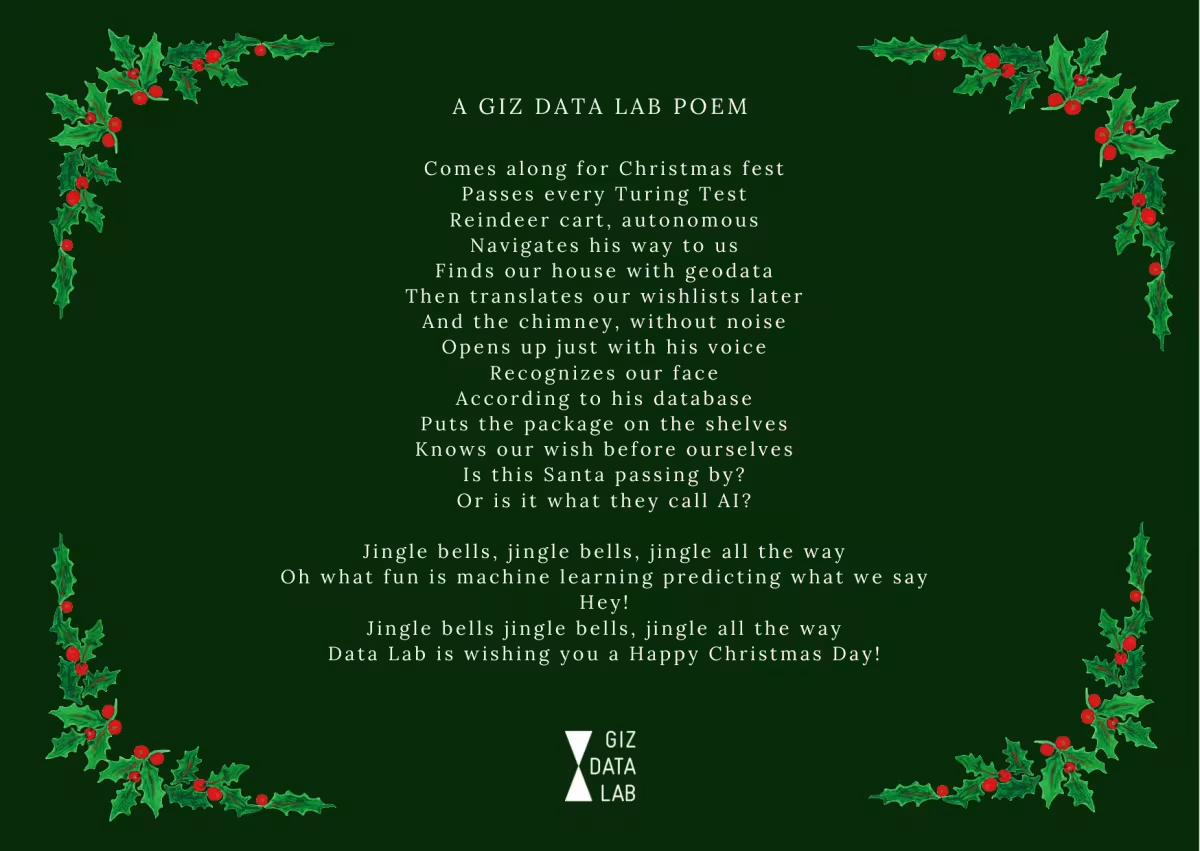
Vanessa brings extensive experience in technology foresight (make sure you don’t miss the potential of GIZ’s techDetector) and supported the implementation of GIZ’s Gender strategy – a perfect match! Her hidden superpower is writing incredible poems – convince yourself below!!
Robin has an energy and climate background AND, during university, managed to send his experiment ideas to space to be implemented by astronauts on the ISS. While the first two qualities – amongst many others – are the reason we are very happy to have him – the ISS adventure is typical for his innovation power and ability to bring the right people together. And isn’t it a GREAT story, too? His hidden superpower is playing around 20 instruments in 30 different bands (or something like that – I guess I lost track).
Lea joined us as an intern in September 2022, and I must admit I am starting to doubt my memory because it feels like she has been with the Data Lab forever. Her proficiency is so outstanding that I sometimes wonder if she faked her CV and has already had a long international career? If someone has seen her in leadership roles before, let me know! I wouldn’t be surprised. Her hidden superpower is being a dog puppy mom in the rough region of Franconia in Germany – if you can make it there, you make it anywhere! I can say that – it is where I grew up. Now one else is allowed to make jokes about it though.
I cannot emphasize enough how happy I am to still count on the support of Erik Lehmann, our Chief Data Scientist. Not only is he an incredible teammate and so much fun to work with, but his Natural Language Processing skills are outstanding. His hidden superpower is the ability to make AI and code sound like easy things to understand, which helps everyone to feel less stupid. What a contribution!
I am extremely happy to count on all of them to leverage the full potential of Data for Development. Thank you, Team Awesome, for all we have achieved together in 2022. And thank you for all where we failed and learned – too!
Catherine Vogel, Head of GIZ Data Lab