
How can digitalisation help address the growing volume of e-waste? What role can digital tools play in supporting recycling facilities improve sorting, processing and reporting data to local and national authorities? And how might 5,000 images from Ghanaian scrapyards contribute to these efforts?
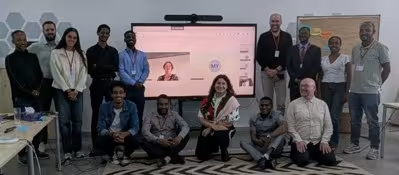
Hybrid Hackday Participants
To find innovative answers to these questions, two actors teamed up: the GIZ Data Lab and the project for “Environmentally Sound Disposal and Recycling of E-Waste Electrical and Electronic Waste”. On behalf of the German Federal Ministry for Economic Cooperation and Development, the project team collaborates with the Ghanaian Ministry of Environment, Science and Technology, the Environmental Protection Authority and a host of formal and informal recyclers. Joining forces with Ghanaian consultants, the team explored how information about e-waste flows and their composition can improve planning and development of business models for collection and recycling facilities and inform pricing policies for subsidised collection schemes of hazardous waste.
From Scrapyards to a Public Dataset
The journey had already begun in October 2025, when a small team of local consultants and experts of the Data Lab spent one and a half weeks collecting around 5,000 images at scrapyards in Accra and Kumasi. These images of e-waste are needed in order to train an artificial intelligence model to classify objects found on the scrapyard. These images became a public dataset, available under a creative commons licence.
Explore the dataset: GIZ/E-Waste-Database on Hugging Face
Creating a dataset of this kind takes time and resources. By sharing this resource publicly, entrepreneurs, researchers and other practitioners are given a foundation for innovation they can build on and reuse.
But making the data accessible was only the beginning. How can curious minds turn this information into practical solutions?
From Data to Innovation: The e-waste Hackathon in Addis Ababa
The answer was found at the GIZ Data Lab e-waste hackathon, which ran throughout September 2026 and culminated in a hybrid event on 28 September in Addis Ababa, as part of African Union Innovation Festival (AU InnoFest) 2026.
Around 15 participants, including AU Tech Fellows , students and founders of e-waste start-ups, came together to explore how data and technology could improve the way e-waste is registered, handled and tracked.
Participants shared ideas and developed innovative approaches to the underlying e-waste management challenge. A case-giver from the e-Waste project in Ghana also provided real-world insights, connecting the discussions to the situation on the ground.
The result? Four innovative solutions exploring how digital tools can improve the tracking of e-waste material flows. One is a data visualisation website that lets users explore the data. The other three are web applications that classify images of e-waste to support material flow tracking. They also provide health hazard warnings, safe-handling instructions, and weight and price estimates. Two of the applications include marketplace features for both buyers and sellers.
What Comes Next?
The hackathon has produced four promising prototypes for material flow tracking apps. The next step is to test them with users on the ground in Ghana and other countries, learn what works in practice and understand how the apps can contribute to better e-waste management. These experiences will then be made available to interested partners in other African countries. By making useful data publicly available and bringing together people with different experiences and perspectives, this initiative creates opportunities for entrepreneurs, researchers and other practitioners to develop solutions to a challenge that extends beyond national borders.
Project Responsible:
Christiane Loquai, Head of E-Waste Project
Catherine Vogel, Head of GIZ Data Lab
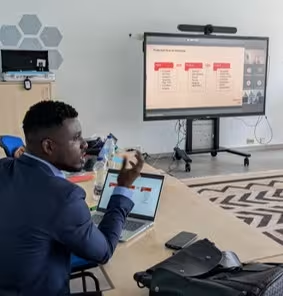
E-Waste Expert Intervention at the hybrid Hackday
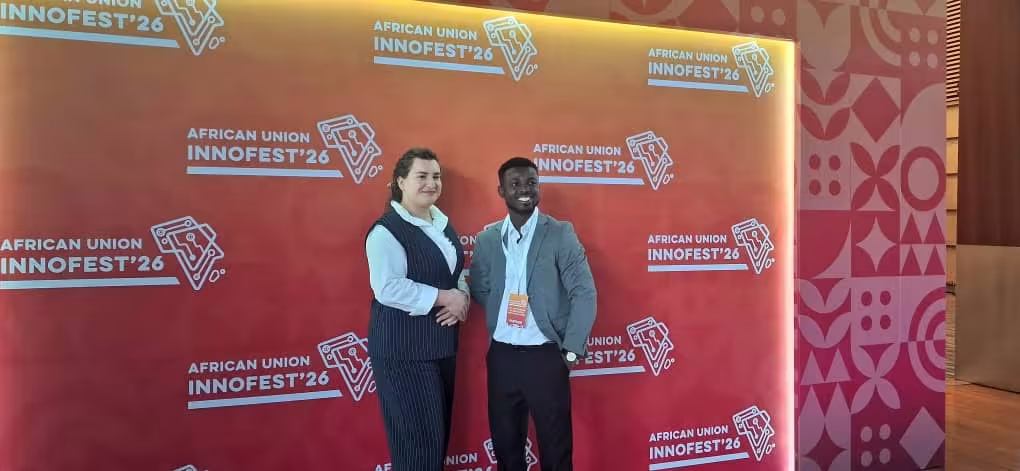
Hackathon Judges at the InnoFest 2026


